

Apple Journal Alternative

The Apple Journal alternative for people who aren't all-Apple.

Apple Journal is a beautiful app — if you live entirely on an iPhone. Reflect is the cross-platform journal for the rest of us: iOS and Android, encrypted by default, with AI insights, voice transcription, and paper-scanning that Apple Journal doesn't offer. Your diary follows you, not your hardware.

iOS & Android Encrypted by default 10 languages
Reflect journal entry on a phone showing typed text, photos, and a voice memo — a cross-platform alternative to Apple Journal

Why people look past Apple Journal.

Apple Journal does its job well for all-Apple users — it's free, native, and its on-device suggestions are clever. The reasons to choose an alternative are almost always about reach, not quality.

01

You're not all-Apple.

You switched to Android, you carry a work Android and a personal iPhone, or you share a phone across platforms. Apple Journal is iPhone-only — no Android, no web. Reflect runs on both, with the same encrypted journal on each.

02

You want AI, voice, and scanning.

Apple Journal is a clean text-and-photo log. Reflect adds AI insights about your patterns, voice notes transcribed to editable text, and OCR that reads a photographed paper page into typed words.

03

You don't want it tied to iCloud.

Apple Journal's backup lives in iCloud and your Apple account. Reflect is encrypted on-device and its backup is unlocked by a recovery code you hold — so it restores on any phone, no Apple account required.

Apple Journal vs Reflect

One journal that crosses platforms.

The single biggest difference is reach. Apple Journal is exclusive to iPhone, which is great until the day you change phones or pick up an Android. Reflect is built for both stores from the same codebase, so an entry written on your iPhone is there, decrypted, on your Android — and the other way around.

  • Native iOS and Android apps
  • Encrypted cross-device sync and backup
  • Restore on a new phone with a recovery code
  • No Apple account or iCloud dependency
  • 10 languages, including Korean, Japanese, Arabic, and Hindi
Reflect restore screen showing encrypted cross-device backup unlocked with a recovery code instead of an Apple account
What Apple Journal doesn't do

AI insights, voice, and paper scanning.

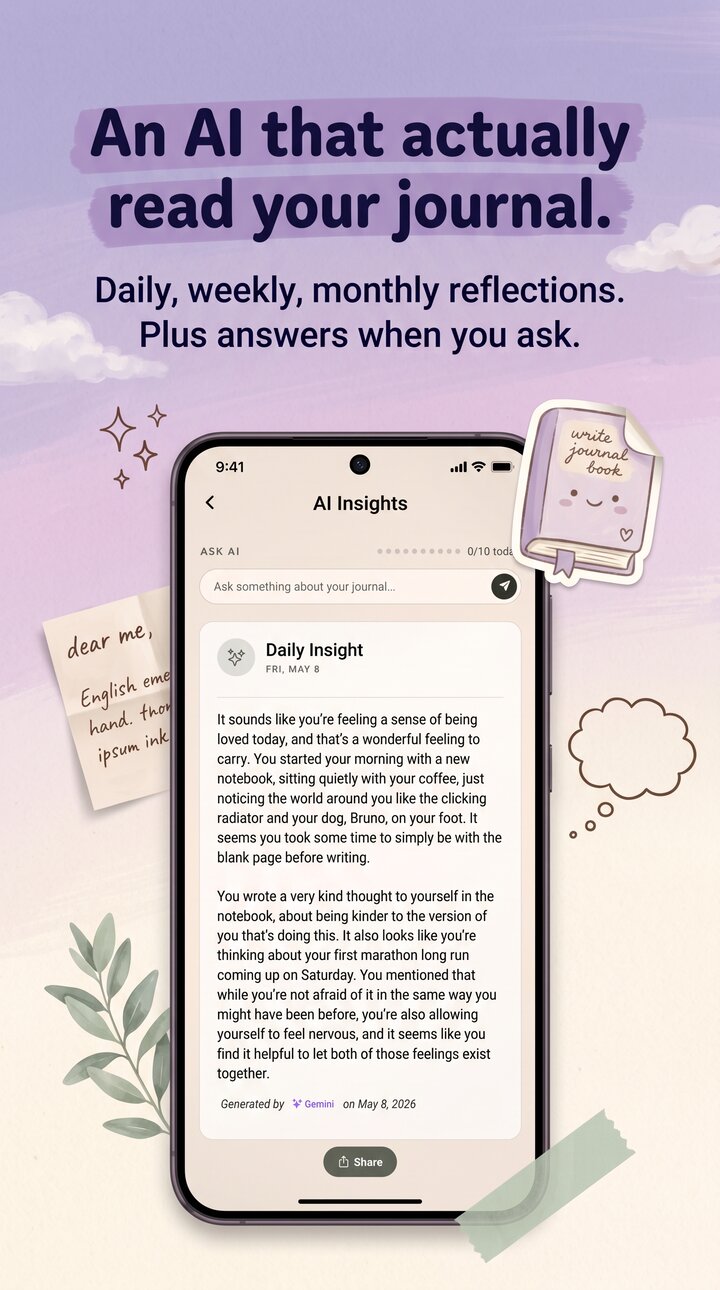
Apple Journal records moments. Reflect reflects on them. Google Gemini reads your entries and writes back daily, weekly, and monthly insights, an MBTI personality read, and answers to questions you ask about your own history. Speak instead of type and it transcribes. Photograph an old paper page and it reads the handwriting into text. Apple Journal does none of that.

  • Daily, weekly, and monthly AI insights
  • MBTI personality reads and Ask AI chat
  • Voice notes transcribed to editable text
  • Paper and photo OCR into typed entries
  • Text is PII-stripped on-device before it reaches the AI
Reflect AI Insights screen showing a Daily Insight written by Gemini — a feature Apple Journal does not have

An honest comparison: Apple Journal vs Reflect.

Let's be fair to Apple Journal first. It launched with iOS 17.2 in late 2023, it's free, it's beautifully designed, and its Journaling Suggestions are genuinely smart — the app quietly surfaces moments from your Photos, the people and places you spent time with, your workouts, and the music you played, then nudges you to write about them. That deep system integration is something only Apple can build, and Reflect doesn't try to replicate it. If you live entirely inside the Apple ecosystem, Apple Journal is a strong, free choice.

The reason people search for an alternative is almost never the writing experience. It's reach. Apple Journal is iPhone-only — no Android app, no web version. The day you move to Android, carry two phones, or someone in your household isn't on an iPhone, the journal doesn't come with you. Reflect is built for that reality: native on both the App Store and Google Play, encrypted on-device with AES-256-GCM by default, with a backup unlocked by a recovery code you keep rather than an Apple account. Type that code on a new phone — iPhone or Pixel — and everything decrypts.

Where Reflect goes further.

Reflect does three things Apple Journal doesn't. It runs AI over your entries — daily, weekly, and monthly insights from Google Gemini, an MBTI personality read, and an Ask AI chat about your own history. It transcribes voice notes into editable, searchable text. And it reads paper: photograph a handwritten page and OCR turns it into typed text. Typed text is PII-stripped on-device before any of it reaches the AI. It's multilingual, too — interface and AI work in 10 languages including Korean, Japanese, Arabic, and Hindi, with right-to-left layout for Arabic.

The trade-offs, stated plainly.

Apple Journal is free; Reflect has a generous free tier with premium for heavier AI use. Apple's suggestions are wired into iOS in a way a third-party app can't match. And there's no clean way to export Apple Journal entries, so moving years of history over isn't a one-tap migration — you'd copy what you want to keep, or re-photograph paper pages and let OCR read them in. If you're all-Apple and happy, stay. If you want a private journal that travels across iOS and Android and does more with what you write, that's where Reflect fits.

FAQ.

Is there an Apple Journal alternative for Android?

Yes. Reflect runs natively on both Android and iOS, so the same encrypted journal follows you when you switch phones or use both. Apple Journal is iPhone-only — there is no Android app and no web version — so the moment you leave the Apple ecosystem your entries stay behind. Reflect keeps yours portable.

What does Reflect do that Apple Journal doesn't?

Three things, mainly. Reflect writes AI insights about your patterns (daily, weekly, monthly, plus an MBTI read and an Ask AI chat) — Apple Journal has no AI writing analysis. Reflect transcribes voice notes into editable text. And Reflect can read a photo of a handwritten paper page into typed text. It also works in 10 languages. Apple Journal's strength is its on-device Journaling Suggestions pulled from your Photos, workouts, and music — Reflect doesn't replicate that deep system integration.

Is Apple Journal private?

Yes — Apple Journal is genuinely private. Entries are encrypted on your iPhone when it's locked and end-to-end encrypted in iCloud, and you can lock the app with Face ID or Touch ID. The trade-off is that its privacy is tied to the Apple ecosystem and iCloud. Reflect is encrypted by default too (AES-256-GCM on-device) but its backup is unlocked by a recovery code you hold, not by an Apple account — so it isn't dependent on iCloud and restores on any phone.

Can I move my Apple Journal entries to Reflect?

Honestly, there's no one-tap importer — Apple Journal doesn't offer a structured export, so no app can pull your entries out cleanly. The practical paths: copy and paste entries you want to keep, or if you also keep a paper journal, photograph the pages and let Reflect's OCR read them into text. Going forward, new entries live in Reflect and travel across iOS and Android.

More from Reflect.

Take your journal across platforms.

Free to start, on iOS and Android, in 10 languages. Encrypted from the first entry. No Apple account required.

Follow