Reflect vs Daylio

Reflect vs Daylio: which diary app fits how you actually journal?

Daylio is the fastest mood-and-activity tracker on the App Store. Reflect is a writing-first private diary with AI insights and AES-256-GCM encryption. Both are good apps — they're built for different humans.

AES-256-GCM by default Voice, photos, paper OCR Free, no ads
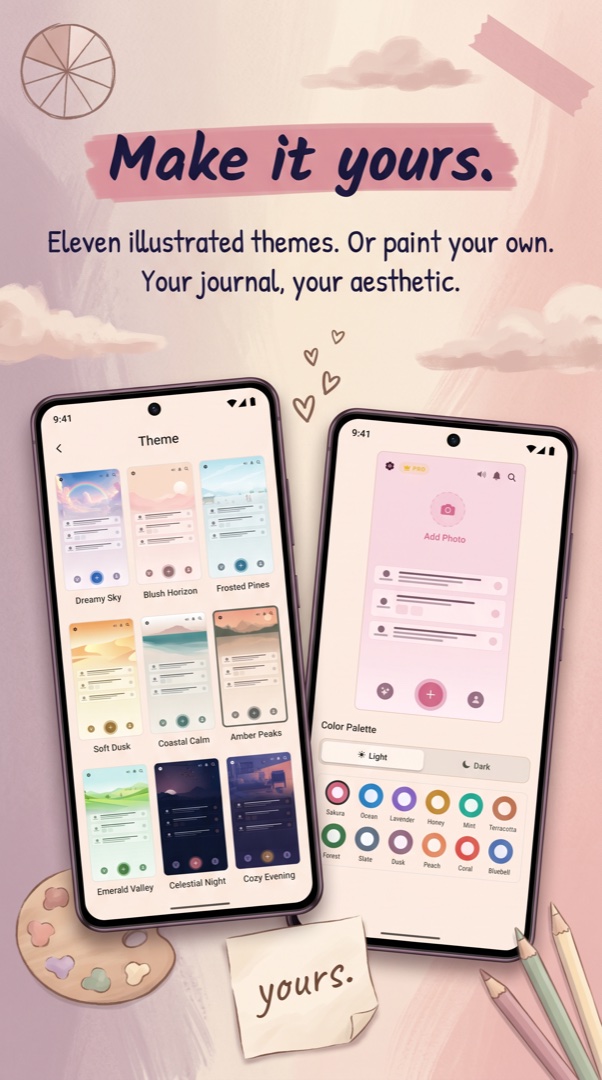
Reflect theme picker on iPhone showing 10 light and dark themes — a writing-first design where Daylio is tap-first

Three honest differences.

No feature-checklist gymnastics. Just where each app actually shines.

01

Mood logging speed.

Daylio wins this cleanly. Tap a face, tap a few activity icons, done in three seconds. If mood-and-activity tracking is 90% of why you open the app, Daylio's tap-tap-done flow is faster than anything Reflect does. Reflect logs mood too — but it's part of a writing screen, not the main event.

02

Encryption at rest.

Daylio protects entries with a PIN lock and stores them locally. That's fine for most threat models. Reflect goes further: AES-256-GCM on every entry, HMAC tamper detection, Argon2id KDF on your recovery code, and zero-knowledge cloud backup — we genuinely cannot read your diary. If your phone is lost, stolen, or restored, that gap matters.

03

AI features.

Daylio doesn't have AI insights, voice transcription, or paper-diary OCR — it isn't trying to. Reflect uses Google Gemini for transcription, OCR, weekly insights, an MBTI-style read, and Ask AI over your own entries. Typed text is PII-stripped on-device before the model sees it. Audio and photos go as-is, honest caveat.

Where Reflect pulls ahead

Long-form writing, voice, photos, paper pages — all encrypted.

Daylio's strength is its constraint: a short micro-note next to your mood. Reflect treats the entry as the centerpiece. You write paragraphs, dictate a voice memo (Gemini transcribes it), drop in photos, or scan a paper journal page with OCR. Every entry is AES-256-GCM encrypted at rest with HMAC tamper detection. Cloud backup is zero-knowledge — your recovery code derives the key on your device.

  • Rich-text writing with 10+ themes
  • Voice journaling — Gemini transcribes in 10 languages
  • Paper-diary OCR for old physical journals
  • Biometric / PIN / password app lock
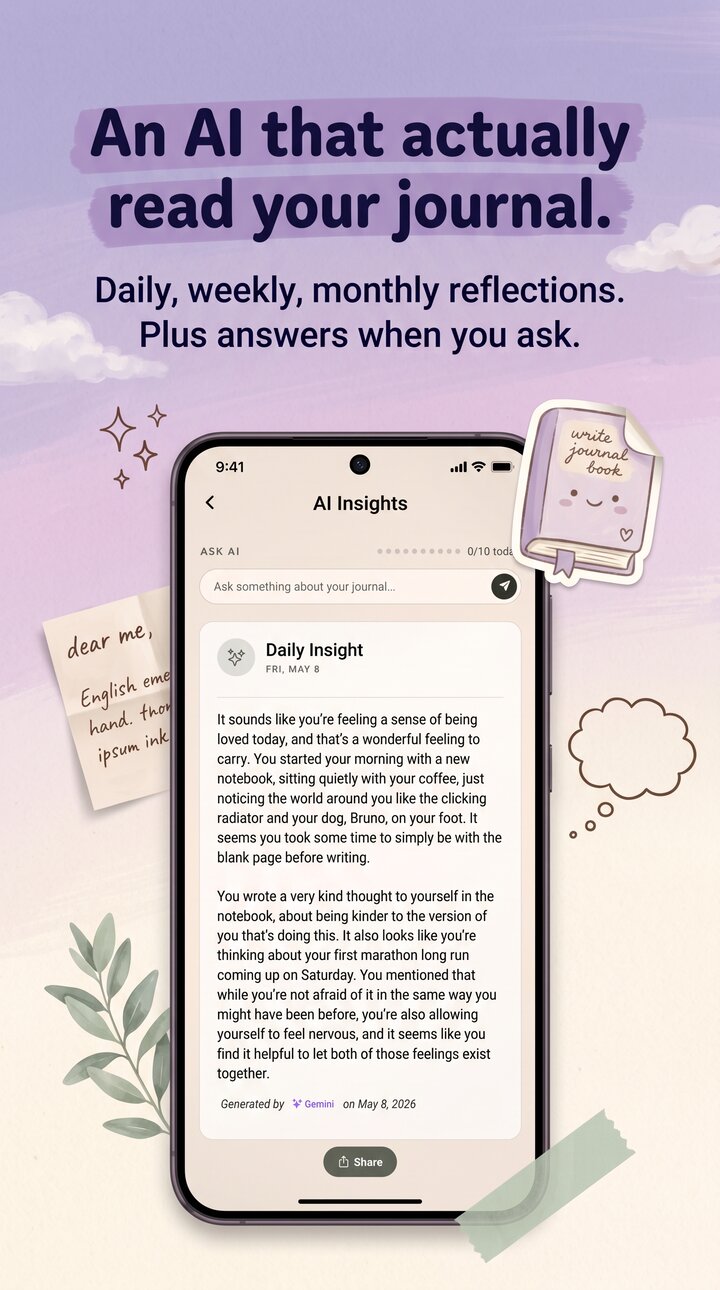
  • Insights, MBTI, Ask AI over your own entries
Reflect AI insights screen on iPhone showing a Daily Insight written by Gemini
Where Daylio pulls ahead

Three-second mood logging and the best mood charts on the store.

Credit where it's due. Daylio's icon-tap UX is genuinely faster than Reflect for the "I just want to log how today felt" use case. Their charts are beautiful, their activity grid is a great habit-tracker, and the free tier is a low barrier to start. If your entries are mostly an emoji and a one-line note, Reflect will feel heavy. We optimize for the person who wants to write paragraphs and have AI read them back. Different tool, different goal.

  • Faster mood-only entry (3 taps vs writing a sentence)
  • Activity-grid habit tracking baked in
  • Polished mood charts across years of data
  • Generous free tier (with ads)
  • One-time Lifetime tier in the same price range as Reflect's
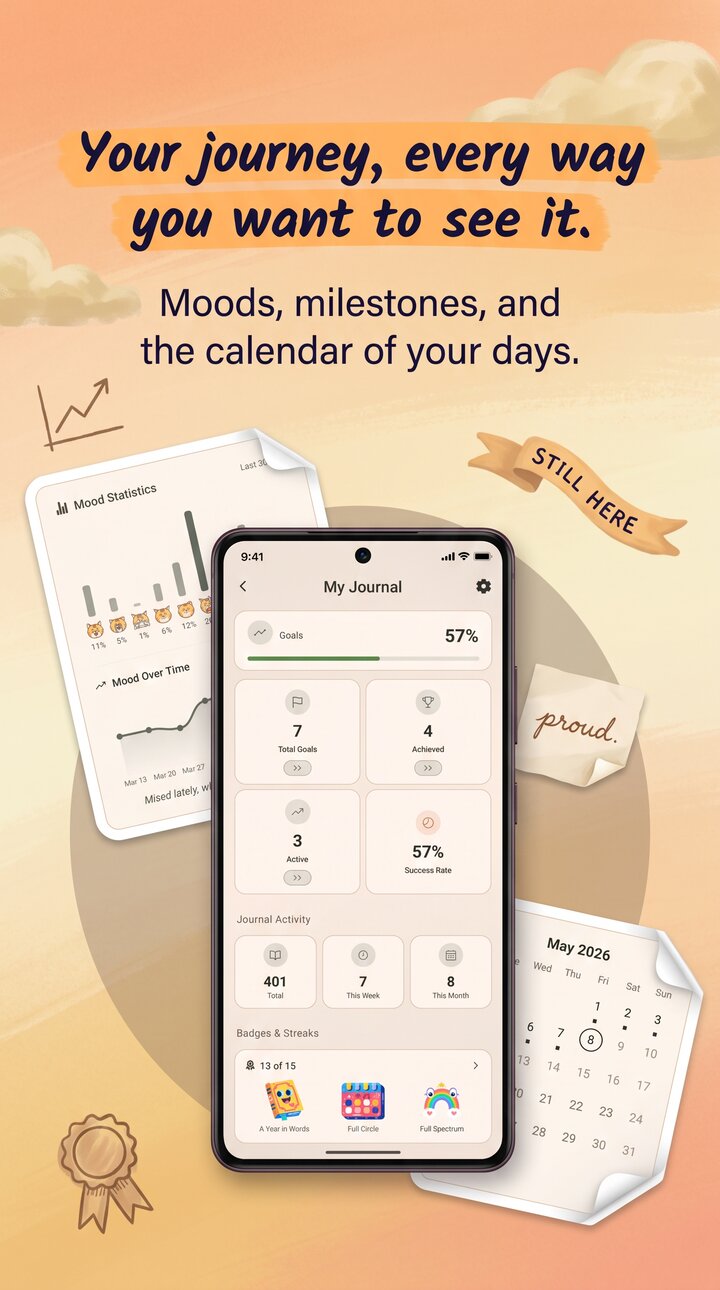
Reflect Journey stats screen showing mood and writing streak over time — Daylio's charts are deeper for mood-only tracking

Should you switch from Daylio to Reflect?

Honest answer: it depends on what "journaling" means to you. If your daily entry is a mood face, three activity icons, and "work was fine" — stay with Daylio. You'd be downgrading on speed and getting features you don't need. Reflect's writing surface, voice recorder, and AI insights only pay off if you actually fill them.

If you've been quietly wanting to write paragraphs, scan your old paper diary, or have an AI summarize your month — and you care that your entries are AES-256-GCM encrypted at rest rather than just PIN-gated — that's the moment to switch. Reflect was built for the longer-form, more private end of the journaling spectrum.

What you give up moving from Daylio to Reflect.

You give up the three-second flow. Reflect's home screen opens to an entry editor, not a mood grid. You give up the activity-icon habit tracker — we don't have a direct equivalent. And you give up Daylio's mood-only chart depth; Reflect's insights are more narrative ("this week you wrote about your sister three times") than statistical. What you gain is zero-knowledge encrypted cloud backup, voice journaling with transcription in 10 languages, paper-diary OCR for old physical notebooks, weekly AI insights, Ask AI over your own entries, an MBTI-style personality read, and Arabic RTL support. If you write at length — or want to — those matter.

Common questions.

Is Reflect cheaper than Daylio?

In the same ballpark. Both have a free tier; Daylio's free tier shows ads, Reflect's doesn't. Both offer one-time Lifetime premium pricing. If you only want mood logging, Daylio's free tier is more generous because mood logging is its main feature.

Can I import my Daylio data into Reflect?

Not directly today. Daylio exports CSV / backup files in its own schema and we don't have a one-click import for it. If this is a blocker, email [email protected] and we'll see how much demand there is.

Does Reflect have Daylio's activity-icon habit tracker?

No. We have mood, location, weather, and stickers on each entry, but no dedicated activity-grid habit tracker. Daylio wins on that specific feature.

Why would I switch from Daylio to Reflect?

If you want to actually write paragraphs, record voice entries, scan a paper diary, get AI insights on your writing, or want AES-256-GCM encryption with zero-knowledge cloud backup. If none of those apply, Daylio is the better fit.

How honest is this comparison?

We wrote it. We tried to be fair — Daylio is genuinely faster for mood logging and has better charts. We point that out twice on this page. The honest position is that these apps are built for different journaling styles, not that one is strictly better.

More from Reflect.

Pick the diary that matches how you actually journal.

Free, in 10 languages, on iOS and Android. No account required. Encrypted from the first entry.

Follow